ABOUT US
We believe plastic can have a better ending.
RNG Plastics is pioneering a new renewable plastic technology designed to preserve the performance and economics manufacturers depend on—while creating a practical pathway away from plastic waste into Renewable Natural Gas and back into productive use.
The world has spent decades trying to solve plastic waste. It hasn’t worked.
Plastic is extraordinarily useful—and extraordinarily persistent. Mechanical recycling has a role, but it cannot economically or practically handle most plastic waste. Recycled materials cost more, perform inconsistently, require constant monitoring, and contamination accumulates through repeated recycling.
Meanwhile, the overwhelming majority of plastic still reaches its end of life disposed in a landfill.
We believed there had to be another path.
A different approach to circularity
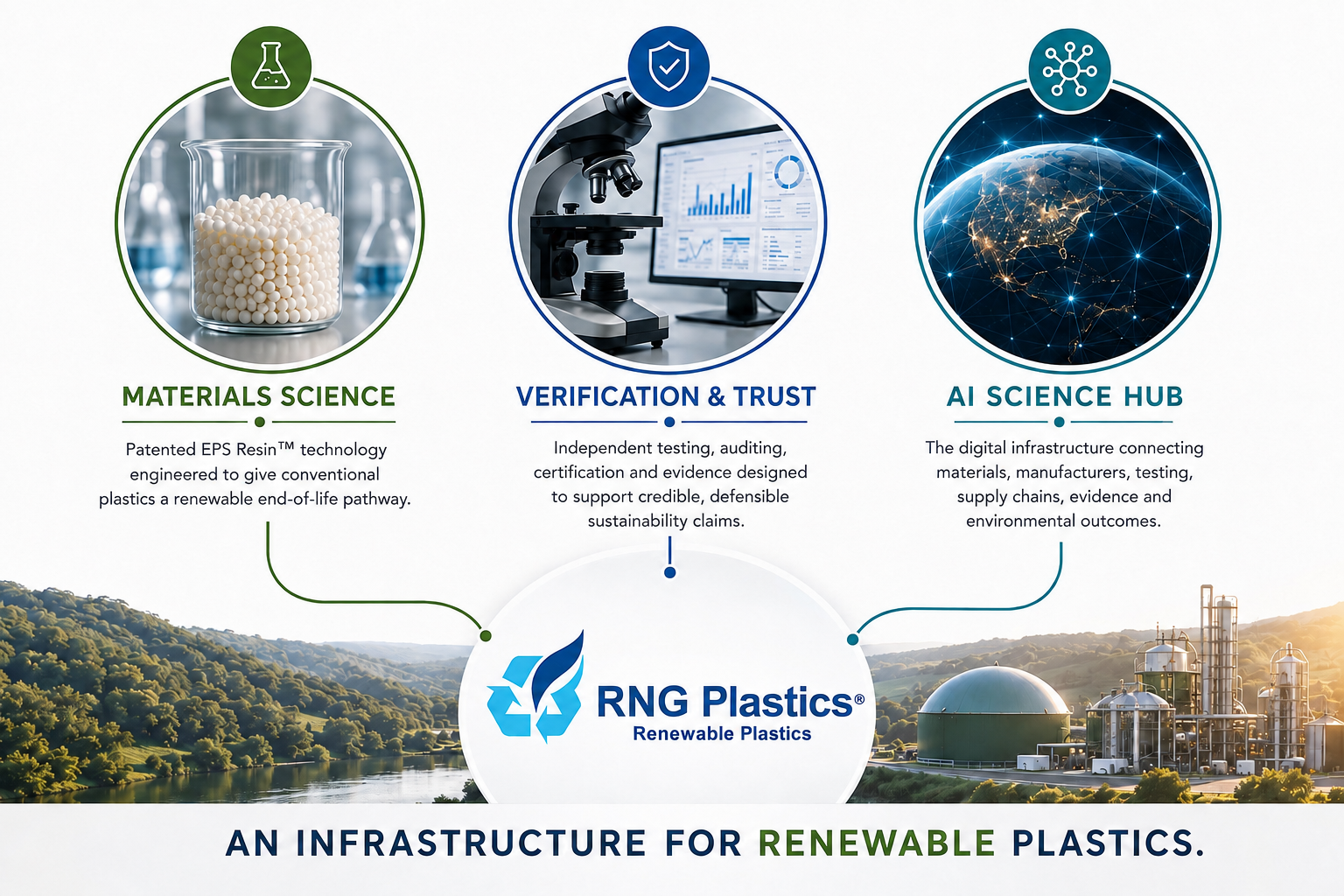
RNG Plastics combines patented materials science, independent testing and verification, and digital traceability to create a practical pathway for conventional fossil-fuel plastics to become renewable plastic.
Manufacturers incorporate only 0.5% of our proprietary EPS Resin™ into compatible plastics during normal production. The resulting RNG Plastics retain the performance manufacturers require while enabling controlled conversion at end of life placement in regulated landfill recovery centers.
The result is conversion into clean biogas (methane and ethane) which is safely captured, processed into RNG feedstock for new materials and applications—creating a circular pathway that works with the infrastructure society already has - EPA-regulated landfills.
We Don’t Think Sustainability Should Require Compromise
For decades, manufacturers have been asked to choose between performance, economics, and sustainability.
We don’t think they should have to.
RNG Plastics was built around a different premise: the sustainable solution has to be a better business solution, too.
That means preserving product performance. Minimizing manufacturing changes. Working with existing supply chains. Providing defensible evidence for environmental claims. And creating measurable economic value rather than simply adding another [supposed] sustainability cost.
It's more than a resin - it's an ecosystem