
Why Mechanical Recycling Falls Short: The Hidden Microplastics Crisis
Mechanical recycling is widely promoted as the gold standard for plastic circularity. Yet for plastics suppliers, manufacturers, and brands in cosmetics, medical devices, and consumer goods, it presents a growing problem: the systematic creation and accumulation of microplastics (MPs) and nanoplastics (NPs)—collectively MNPs.
These invisible particles are not just an environmental issue. Peer-reviewed research shows they penetrate human tissues, trigger chronic inflammation, and are linked to serious health conditions.
RNG Plastics offers a fundamentally different, defensible solution: a landfill-safe technology that bypasses mechanical recycling’s contamination risks while enabling controlled conversion into renewable natural gas (RNG) with verifiable carbon credits
The Promise vs. Reality of Mechanical Recycling
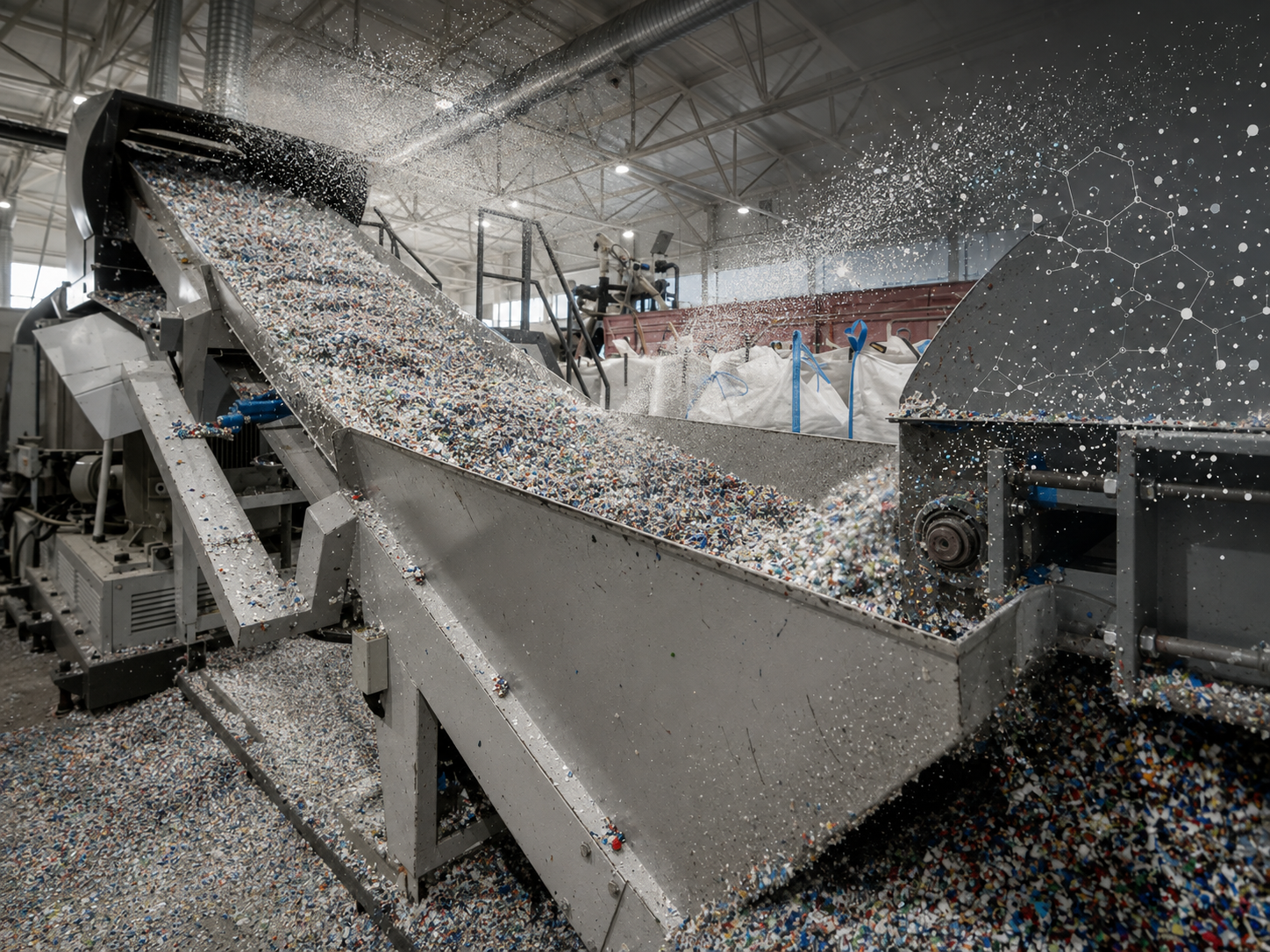
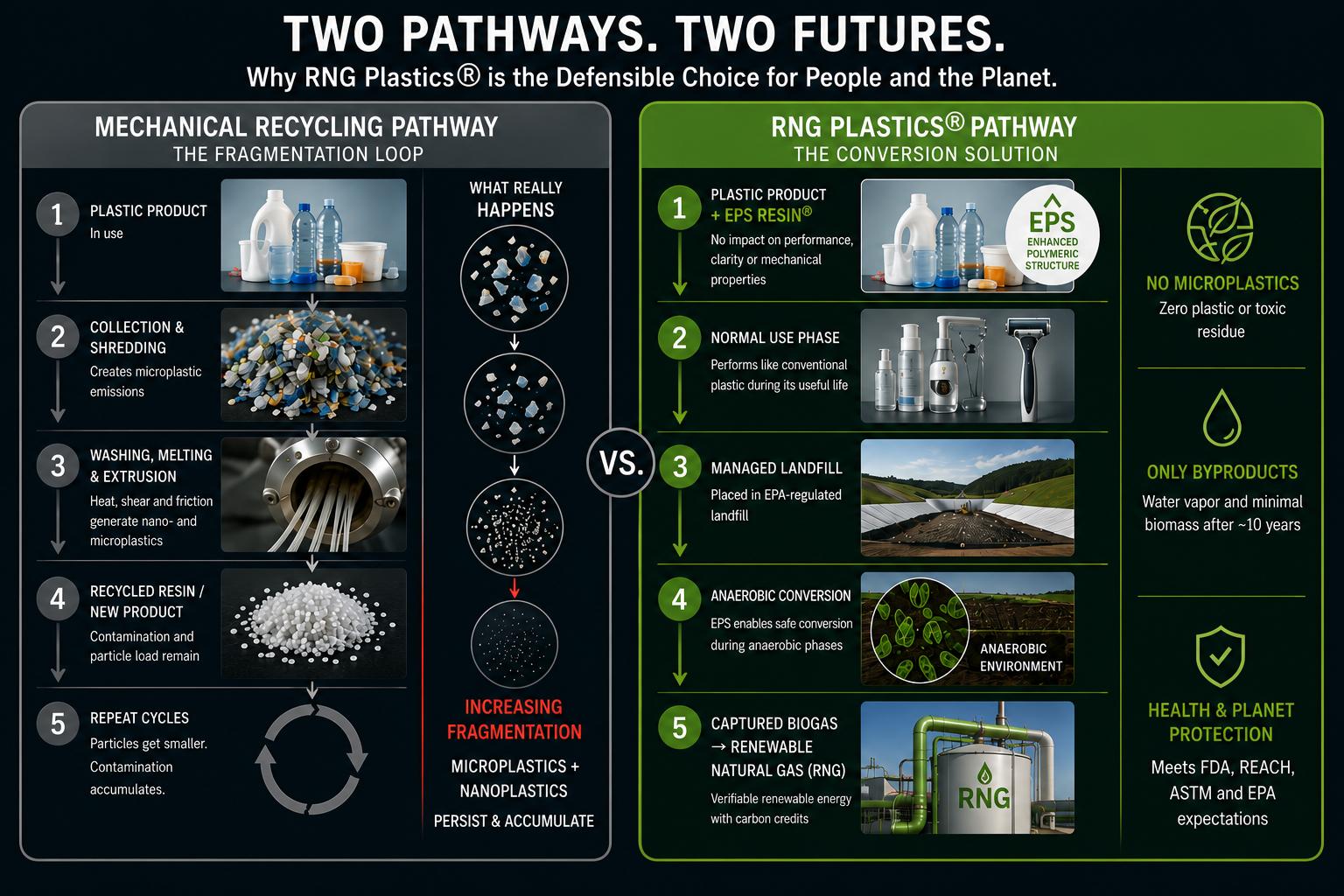
Mechanical recycling involves collecting, sorting, shredding, washing, and extruding plastics into new resins. While it diverts some waste, the process itself generates MNPs at every stage.
Key limitations include:
- Particle Generation During Processing: Shredding and extrusion create airborne emissions of 22,000–1,300,000 particles/cm³ in the nano-range (10–420 nm). Each cycle fragments plastics further and introduces new contaminants from inks, adhesives, and cross-stream mixing.
- Accumulation Over Cycles: After 1–3 recycling loops, nano-particle counts can reach 10⁴–10⁵ per gram. Standard washing misses particles <100 nm. Even advanced methods like supercritical CO₂ are too costly for scale.
- Regulatory Gaps: Standards (FDA, APR, EU REACH) focus on macro-impurities and short-term migration limits. They do not adequately address chronic nano-scale accumulation.
The Human Health Implications
Emerging science paints a concerning picture. MNPs cross biological barriers and act as vectors for additives and pathogens.
A landmark 2024 NEJM study of 304 patients undergoing carotid endarterectomy found:
- Polyethylene in 58.4% of plaques
- PVC in 12.1%
- Patients with MNPs faced a 4.53-fold higher risk (HR 4.53) of myocardial infarction, stroke, or death over ~34 months.
Additional links include oxidative stress, neuroinflammation, reproductive harm, and more. For medical suppliers and cosmetics brands, where human contact is direct and prolonged, this risk is unacceptable.
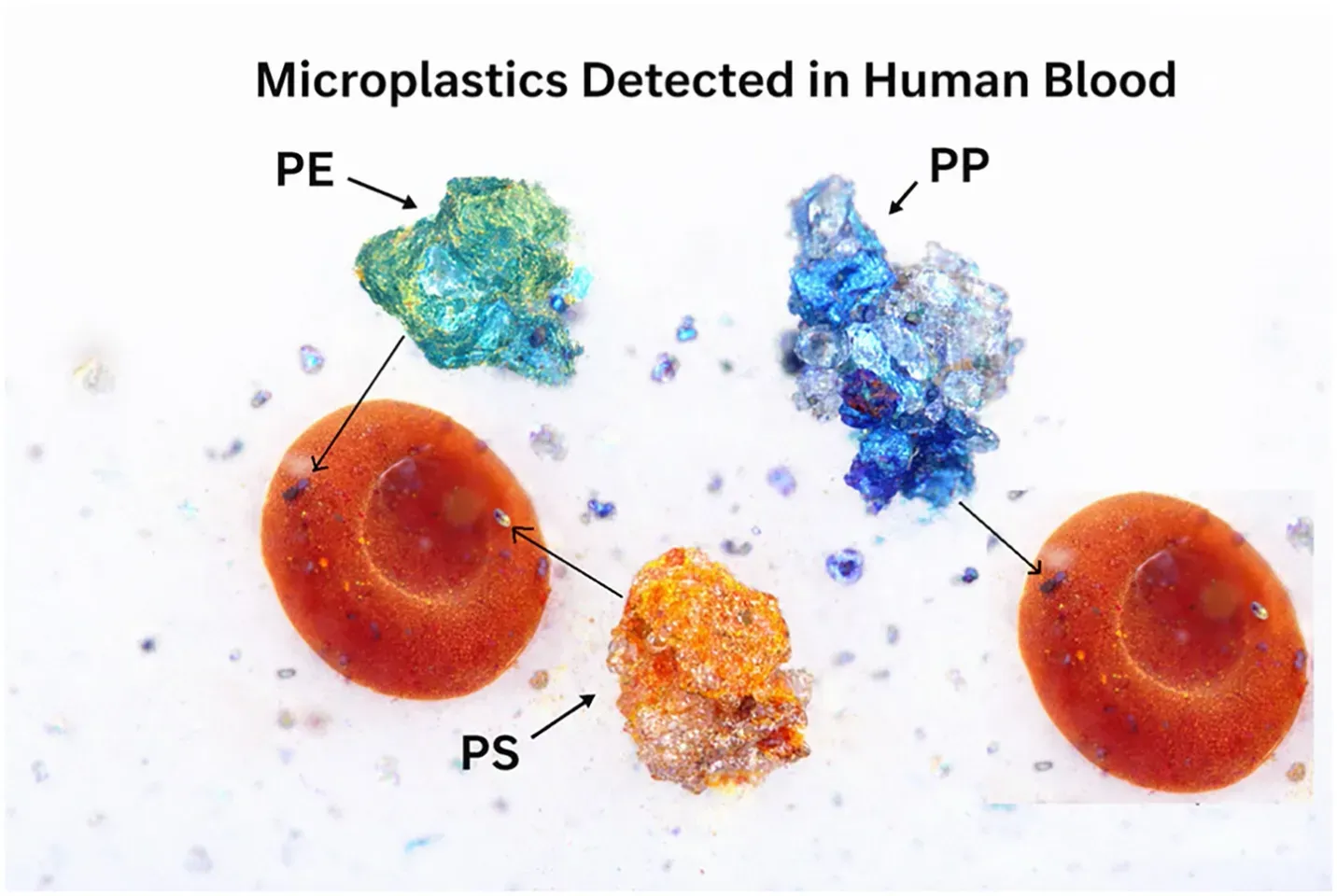
Representative images showing microplastics detected in human blood (PE—polyethylene; PP—polypropylene; PS—polystyrene). Source: Public awareness, knowledge gaps, and health anxiety concerning microplastics in human blood: a cross-sectional survey of Indian adults, Frontiers In Public Health.
Why Zero Contamination Is the Only Defensible Standard
Recyclers and many standards treat low-level contamination as “acceptable.” But for health-conscious applications, zero contamination is non-negotiable.
RNG Plastics achieves this through its proprietary Enhanced Polymeric Structure (EPS) resin:
- Added at low levels to standard PE, PET, PP, PVC, etc.
- No impact on mechanical properties, clarity, or performance during use.
- Remains inert until reaching EPA-regulated landfills.
- Enables safe, controlled conversion into RNG during anaerobic phases — leaving no microplastics, no toxins, and no waste (only water vapor and minimal biomass after ~10 years).
This aligns with FDA, REACH, and ASTM standards while avoiding the MNP burden of mechanical recycling.
Time to Move Beyond Incremental Fixes
Mechanical recycling has an important role but falls short for applications demanding true safety and circularity. RNG Plastics provides a scientifically engineered, EPA-aligned alternative that protects human health, captures renewable natural gas, and delivers monetizable sustainability outcomes.
Ready to future-proof your plastic formulations? Register to get started and explore pilot programs. Integrate EPS resins seamlessly, validate performance, and start claiming verified carbon credits today.