- NO MICROPLASTIC CONTAMINATION
- NO GREENHOUSE EMISSIONS
- SAFE & CONTROLLED RENEWAL
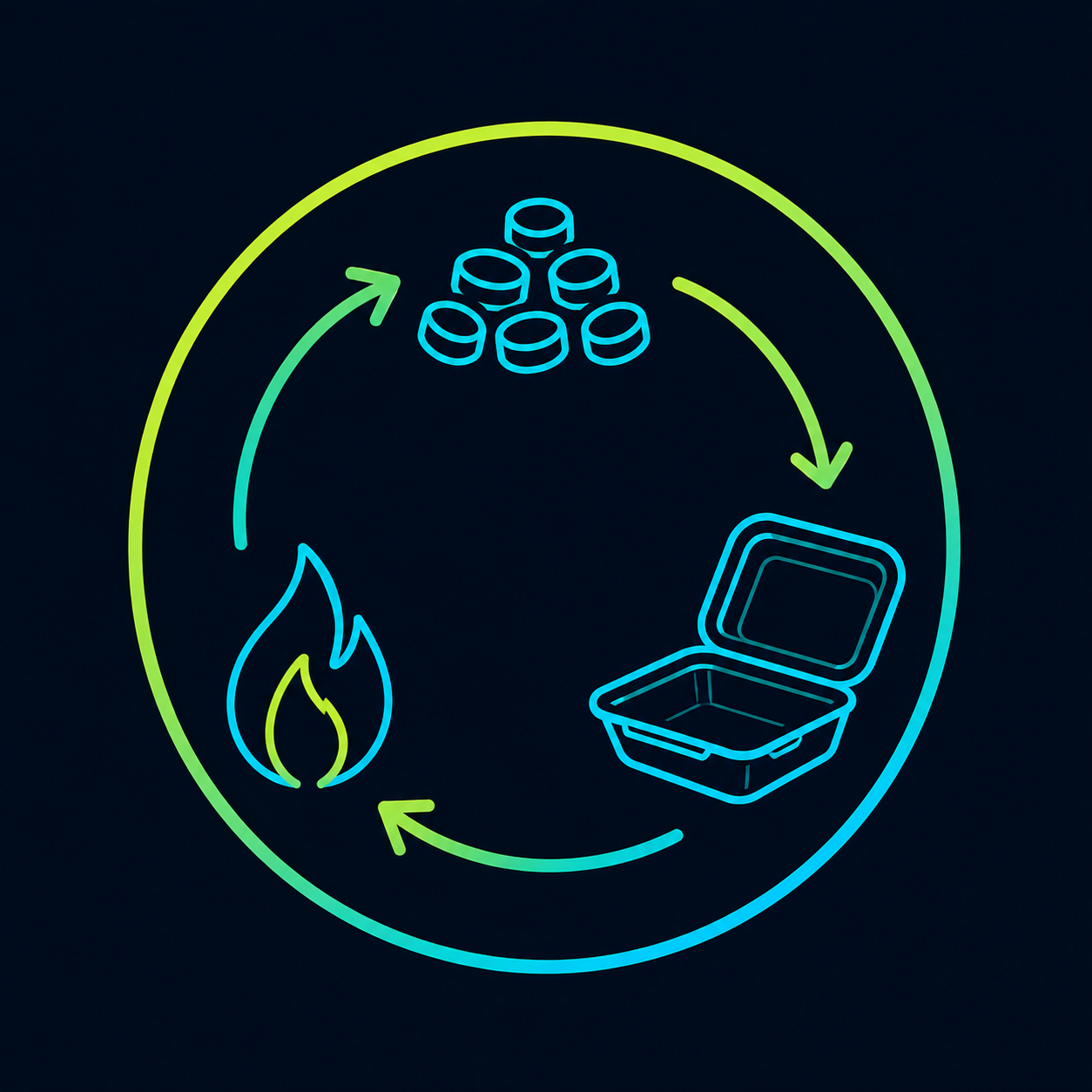
- TRUE CIRCULAR ECONOMY

A Small Addition with Big Changes at End of Life
EPS Resin™ is a proprietary material technology incorporated into conventional plastic during manufacturing.
At ~0.5% of the formulation, EPS Resin is designed to alter how the polymer behaves under specific end-of-life conditions—without replacing the base resin or changing what the plastic is expected to do during its useful life.
The result is familiar, high-performance plastic with a new pathway after it arrives at an EPA-regulated landfill.
Designed for Use First. Renewal Later.
RNG Plastics are engineered to remain plastics while they are products—and to be converted into RNG when they reach the right end-of-life environment.
- During Manufacturing: Designed to integrate into conventional plastic processing.
- During Useful Life: Maintains the performance expected from the primary polymer.
- At End of Life: Five specific environmental, physical, and biological conditions enable the conversion pathway.
It's better than recyclable. It's RENEWABLE.
No Plastic Fragmentation - No Microplastic
Unlike bioplastics and bio-accelerators - RNG Plastics are entirely different.
Bioplastics and conventional plastics using bio-accelerators start degrading the day they are made, breaking down, fragmenting, and creating microplastics—but not RNG Plastics! They remain in full performance mode until after they are placed in the engineered EPA-regulated landfill recovery centers.
RNG Plastics are designed for a different pathway:
Under controlled conditions at EPA-regulated recovery centers, our proprietary technology uses five physical phenomena to safely convert the once "conventional fossil fuel plastic" back into its original natural gas feedstock - at the molecular level. The proprietary process using EPS Resins is the key. Best of all it is a zero-contamination solution.
No New Waste Stream Required
Many recyclable technologies depend on consumers correctly identifying, separating, cleaning and returning material through a dedicated collection and sorting system.
RNG Plastics takes a different approach.
The technology is designed around an end-of-life pathway already used for large volumes of ordinary waste: Using the existing waste recovery system, when they arrive at the EPA-regulated landfill they are temporarily placed in its methane recovery infrastructure (over 85% of landfills in the US) - and converted right back into RNG.
The technology does not depend upon creating a new consumer or industrial collection system before it can work.